
Padel Racket Weight Tolerance Deep Dive: A Complete Guide from Production to Quality Control
Padel Racket Weight Tolerance Deep Dive: A Complete Guide from Production to Quality Control
As a Padel racket manufacturer, we are frequently asked by brand clients the same question: "Why do rackets of the same model vary in weight? Is ±5g truly the limit for tolerance?"
This article provides a professional manufacturing perspective on the causes of weight tolerance in Padel rackets, industry standards, and how we implement layered quality control throughout the production process.
1. Industry Weight Tolerance Standards
In the Padel racket industry, weight tolerance is a key indicator of manufacturing precision. Different brand positioning and product lines adopt different standards:
| Product Positioning | Typical Tolerance Range | Application Scenarios |
|---|---|---|
| High-End / Professional | ±5g | Professional player rackets, flagship series |
| Mainstream Consumer | ±5g ~ ±7g | Most mid-to-high-end retail products |
| Entry-Level / Economy | ±7g ~ ±10g | Club rental rackets, entry-level products |
It should be noted that ±5g is currently recognized as the highest precision level that can be stably achieved under mass production conditions in the industry.
This standard is also corroborated by actual product data from major brands. For example, Nox's Advance series lists a weight range of 360–375g, representing a tolerance of ±7.5g, while Bullpadel's VERTEX 05 PRETORIA lists 365–375g, representing a tolerance of ±5g.
Professional Recommendation: If your brand is positioned in the high-end segment, we recommend setting the weight tolerance at ±5g. If targeting the entry-level or club rental market, ±7g to ±10g is a more economically viable option.
2. Why Do Padel Rackets Have Weight Tolerance?
Core Reason: Production Process is Largely Manual
This is the key to understanding the weight tolerance issue. Contrary to what many imagine, Padel racket production is far from a fully automated assembly line. The manufacturing of Padel rackets is characterized by "moderate variability in a highly manual process."
Specifically, weight deviation mainly comes from the following stages:
After thermoforming, the racket surface is not perfectly flat and requires multiple rounds of manual sanding, putty filling, and paint application. Each of these manual operations removes or adds a small amount of material, and the precision of these operations relies entirely on the experience and skill of the workers.
3. Weight Control Checkpoints Throughout Production
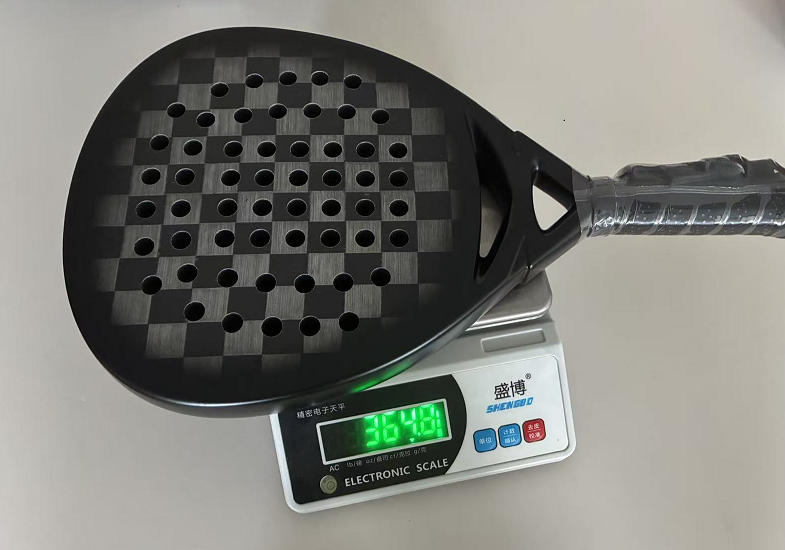
To ensure that finished rackets fall within the tolerance range, we have established multiple weighing checkpoints throughout the production process:
3.1 After Molding (Raw Blank Weighing)
After demolding from thermoforming, the racket is in its "raw blank" state. The first weighing is conducted at this stage to record the initial weight.
3.2 After Sanding
After the raw blank surface is sanded to remove burrs and flash, a second weighing is performed. The amount of material removed during sanding directly affects the final weight, making precision control at this stage critical.
3.3 After Putty Filling
If there are pores or uneven areas on the surface after sanding, putty is applied to fill them. After the putty cures and is sanded smooth, a third weighing is conducted. Putty adds weight, so precise control of putty application is essential.
3.4 After Painting
The multi-layer application of primer, color paint, and clear coat significantly increases weight. A fourth weighing is performed after the paint has cured. Different colors and different paint film thicknesses have a notable impact on weight.
3.5 After Final Assembly (Final Inspection)
After installing the grip, wrist strap, butt cap, and other components, the final weighing is conducted. This is the last checkpoint before shipping — only rackets that fall within the tolerance range can be labeled and packaged.
4. Other Factors Affecting Racket Weight
In addition to the variables introduced by the production processes above, the following factors also have a significant impact on the final weight:
4.1 Component Variations
-
Wrist Strap: Different materials and designs can vary by 5–6g. Nylon woven straps are lighter, while those with metal buckles or thickened leather are noticeably heavier.
-
Butt Cap: Different styles of butt caps typically vary by 2–4g.
4.2 Paint Finish and Color
-
Color Paint vs. Clear Coat: Darker or more vibrant colors often require thicker coatings to achieve full coverage, which significantly increases weight. In contrast, a black clear coat finish is lighter.
4.3 Drilling Parameters
-
Hole Diameter and Count: The number and diameter of holes on the racket face directly determine the amount of material removed. Hole diameters typically range from 9–13mm, with counts of 50–70 holes. Each additional hole removes a small amount of weight.
-
Hole Distribution: Whether holes are concentrated in the center or evenly distributed also affects weight distribution and balance point.
4.4 Grip Length
A longer grip requires more carbon fiber wrapping material and a longer grip tape. While the impact on a single racket is small, it accumulates as a systematic deviation in batch production.
4.5 Surface Finish
Choosing between matte, gloss, or matte/gloss with textured paint also affects weight. Textured (granular) paint finishes add additional weight compared to smooth finishes.
5. Summary
Weight tolerance in Padel rackets is not a manufacturing defect, but rather an inherent characteristic of handcrafted production processes. The key takeaways are:
-
Clear Industry Standards: High-end brands target ±5g, while economy products accept ±7–10g. ±5g is the practical upper limit of precision under mass production conditions.
-
Manual Processes Are the Primary Cause: Sanding, putty filling, and painting all rely on manual labor, making it difficult to achieve perfect consistency in material removal and addition — this is the fundamental reason for weight tolerance.
-
Multiple Quality Control Checkpoints: From raw blank to finished product, we implement 5 or more weighing checkpoints to ensure every racket meets tolerance requirements before leaving the factory.
-
Weight Is Not the Sole Indicator of Quality: Wrist straps, paint finishes, drilling patterns, grip length, and other design choices all affect final weight. Brands should consider these factors holistically during the product design phase.
Our Commitment: Our pursuit of strict quality control is not about making the numbers on the label look perfect — it's about ensuring that every racket in every player's hand delivers stable, reliable performance on the court.



Contact Us