
Padel Racket Surface Finishing: A Complete Technical Guide from Glossy to 3D Textures
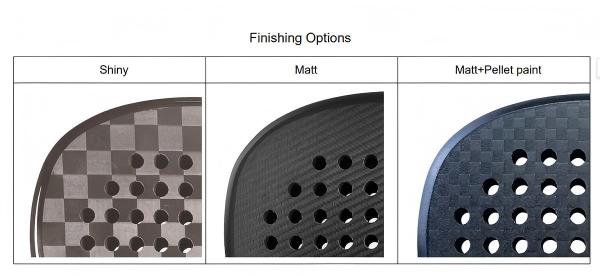
Padel Racket Surface Finishing: A Complete Technical Guide from Glossy to 3D Textures
As a professional manufacturer, we understand that a racket's surface finishing is not merely about visual appeal—it directly impacts hitting feel, spin generation, and product longevity. This article provides a systematic analysis of mainstream finishing technologies, their technical characteristics, cost structures, and market trends, serving as a reference for product development and procurement decisions.
1. Surface Finishing Types and Terminology
The most common finishing solutions in the industry include the following categories, with corresponding English terms for international business communication:
| Finish Type | English Terminology |
|---|---|
| High-gloss / Shiny finish | Glossy / High-gloss / Shiny finish |
| Matte finish | Matte finish |
| Matte + Sand texture | Matte + Pellet paint / Sand texture / Sandy finish / Grit coating |
| Matte + 3D water decal | Matte + 3D water decal / 3D transfer decal |
| Matte + 3D decal + Sand texture | Matte + 3D decal + Pellet paint / Hybrid surface with 3D relief |
"Pellet paint" is also commonly referred to as "sand-blasted finish" or "silica-based coating"—a rough surface achieved by spraying a coating containing sand or quartz particles. "3D water decal" refers to the water transfer printing process that transfers pre-printed patterns onto the racket surface, enabling three-dimensional texture effects.
2. Advantages and Disadvantages of Each Finish
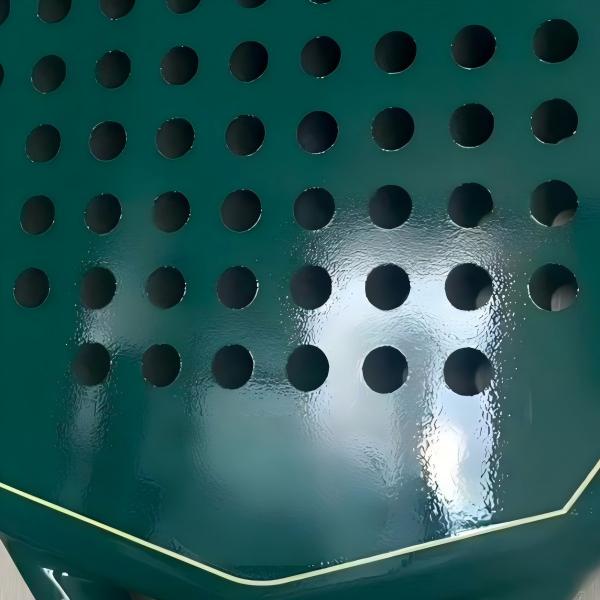
2.1 Glossy / High-gloss Finish
Advantages:
-
Smooth surface with relatively low air resistance, suitable for players prioritizing shot speed
-
Bright, vibrant appearance with clear brand logo presentation
-
Low basic manufacturing cost with mature processing technology
Disadvantages:
-
Low friction coefficient, limited spin generation capability
-
Fingerprints and scratches are more visible; durability is moderate
2.2 Matte Finish
Advantages:
-
Premium, understated visual texture—a major design trend in recent years
-
Offers slightly more friction than glossy finish
Disadvantages:
-
Plain matte without rough treatment provides limited spin assistance
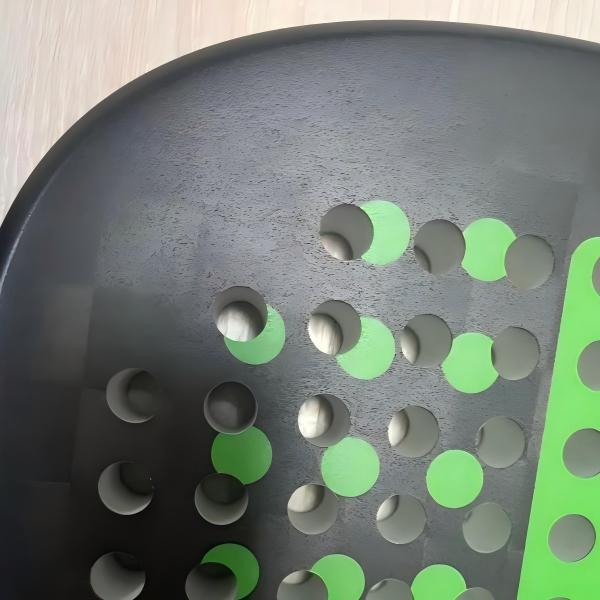
2.3 Matte + Sand Texture (Pellet Paint / Sandy Finish)
Advantages:
-
Exceptionally high initial spin performance: Sand particles create strong friction with the ball felt, ideal for slices, topspin, lobs, and other technical shots
-
Soft feel with pronounced "ball-gripping" sensation
Disadvantages:
-
Significant performance degradation: Sand particles exposed on the surface gradually wear down and flatten with use, leading to declining spin performance
-
Under high-frequency use, feel changes noticeably within months to half a year
2.4 Matte + 3D Water Decal (Matte + 3D Decal)
Advantages:
-
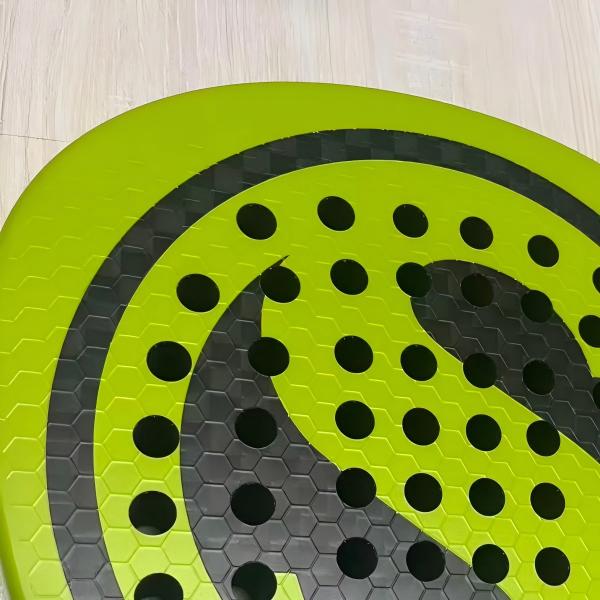
Strong design expressiveness: Enables three-dimensional, geometric, honeycomb, and other complex patterns with high-tech aesthetics and brand recognition
-
Durable structure: Textures are mold-formed or heat-embedded, not dependent on surface-attached particles—they don't "wear off"
-
Stable spin performance with minimal change over time
Disadvantages:
-
Initial "bite feel" is less pronounced compared to sand-textured surfaces
-
Spin relies primarily on swing speed; less assistance for slow-speed techniques
2.5 Matte + 3D Decal + Sand Texture (Hybrid / Composite Surface)
Advantages:
-
Optimal performance solution: Dual spin-generation mechanisms combining mechanical bite from 3D structures with friction assistance from sand particles
-
Balanced durability: After sand particles wear down, 3D textures continue to perform, resulting in a gentle performance decline curve—a smooth transition from "sand-dominated" to "texture-dominated" feel
-
Adapts to full-scenario performance across different swing speeds
Disadvantages:
-
Complex processing with demanding production control requirements
3. Short-term vs. Long-term Performance Comparison
| Surface Type | Initial Spin | After 3–6 Months | After 1 Year | Feel Consistency |
|---|---|---|---|---|
| Sand Texture | ⭐⭐⭐⭐⭐ | ⭐⭐⭐ | ⭐⭐ | feel changes significantly with wear |
| 3D Texture | ⭐⭐⭐ | ⭐⭐⭐ | ⭐⭐⭐ | stable performance |
| Hybrid (3D+Sand) | ⭐⭐⭐⭐ | ⭐⭐⭐⭐ | ⭐⭐⭐⭐ | gradual, smooth performance transition |
| Glossy/Matte (Smooth) | ⭐⭐ | ⭐⭐ | ⭐⭐ | but inherently limited spin capability |
4. Cost Structure Analysis
Glossy, Matte, and Pellet Paint (sand texture) are all achieved through spraying processes, with similar material and labor costs—overall differences are minimal. Water Decal involves additional 3D texture-forming steps on top of plain water decal application, increasing process complexity and resulting in a slightly higher cost.
5. Application Scenarios and Player Matching Recommendations
| Surface Type | Recommended Player Type | Compatible Racket Shapes | Scenario Description |
|---|---|---|---|
| Glossy/Matte (Smooth) | Beginners, power-oriented players | Round / Teardrop | Prioritizes shot speed; does not rely on spin assistance |
| Sand Texture | Spin-dependent, feel-oriented players | Teardrop / Diamond | Technique-driven play emphasizing lobs, slices, and topspin |
| 3D Texture | Advanced players, power hitters | Diamond | Players with sufficient swing power who seek stable, predictable spin feedback |
| Hybrid Surface | Intermediate to advanced players, high training frequency | All shapes | Balances spin needs with durability; currently the most favored by competitive players |
6. Market Sales Data and Trend Insights
Current Market Preferences
-
Hybrid Surface (Sand + 3D) — Mainstream choice for mid-to-high-end performance rackets
-
Optimal balance of performance and durability
-
Adopted by most brands' flagship models
-
-
Sand Texture (Sandy Finish) — Widely used in mid-range and entry-level performance rackets
-
Appealing initial feel, suitable for retail trial experiences
-
Controllable cost with a "tech-savvy" visual appeal
-
-
Glossy/Matte (Smooth) — Entry-level and economy products
-
Cost-driven, suitable for mass market and club bulk purchases
-
-
Pure 3D Texture — High-end professional series
-
Suitable for players seeking stable durability
-
Conclusion
In the selection of padel racket surface finishing processes, there is no absolute "best" solution—it depends on the alignment of product positioning, target audience, and cost strategy. The hybrid surface represents the current optimal technical solution, ideal for mid-to-high-end competitive products; sand texture wins the retail market with its outstanding initial feel; 3D texture serves professional players pursuing long-term stability. As a manufacturer, our value lies in helping clients make optimal decisions across these technical pathways, and in precisely realizing design intent through rigorous quality control.
For discussion of finishing solutions for specific product lines, please contact our technical team for customized recommendations.



Contact Us