
Padel Racket Material Guide: From UD to 24K
- 2025-12-04 15:33:26
- Visoncarbon
- Padel Rackets
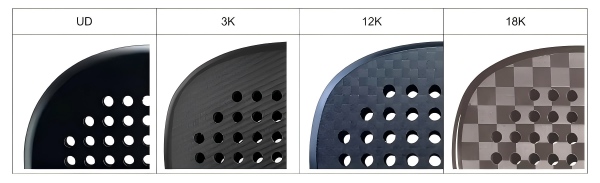
1. Material Options Overview
Common carbon fiber materials for padel racket surfaces:
-
UD (Unidirectional)
-
Woven fabrics: 3K, 6K, 12K, 15K, 16K, 18K, 24K
2. Definition of UD and "K"
UD (Unidirectional) : All fibers align in the same direction with no weave structure.
-
Theoretically very high axial modulus, but entry-level products use only thin layers (1-2 plies), resulting in limited overall stiffness, poor impact resistance, and a harsh, vibration-prone feel.
-
Market positioning: Entry-level
Meaning of "K" : Number of filaments per carbon fiber tow (in thousands).
-
3K = 3,000 filaments
-
12K = 12,000 filaments
-
24K = 24,000 filaments
Key insight: Higher K does NOT mean stiffer. In padel, high K (18K/24K) actually feels softer and more flexible.
3. Microstructure: The Source of Feel Differences
Two levels to distinguish:
| Aspect | 3K | 24K |
| Intra-tow (inside a tow) | Filaments tightly bonded by resin | Equally tight (no difference) |
| Inter-tow (between tows) | Flat tow shape, tightly woven, tows lock together | Thick round tow shape, loosely woven, tows can slide against each other |
Conclusion: The "soft and elastic" feel of 24K comes from sliding between thick fiber tows, not from internal looseness.
4. Market Positioning and Performance Comparison
| Material | Market Positioning | Actual Feel | Power Output | Control/Spin | Recommended Shape |
| UD | Entry-level (beginner) | Stiff, vibration-prone | Low | Low | Round |
| 3K | Mid-tier mainstay (intermediate) | Hard, crisp, precise | High | High | Diamond/Teardrop |
| 6K | Mid-tier (intermediate) | Hard with some toughness | Medium-High | Medium-High | Teardrop |
| 12K | Mid-High (intermediate to advanced) | Balanced, stable | Medium | High | Teardrop/Round |
| 15K/16K | High-end (defensive/counter-attack, technical) | Soft, high dwell time | Medium-Low | Very High | Round |
| 18K/24K | High-end/Pro (technical, elbow protection) | Soft-elastic, excellent dampening | Low | Very High | Round |
Important Clarification: Round Shape ≠ Beginner Racket
-
Entry-level round rackets: UD material, low cost, high forgiveness
-
Pro-level round rackets: 18K/24K material, designed for elite control players, longer dwell time, more spin, elbow-friendly
5. Price Gradient
UD < 3K < 6K < 12K < 15K/16K < 18K < 24K
| Grade | Material | Cost Reason |
| Entry | UD | Simple process, fewer plies |
| Mid-tier | 3K, 6K | Mature weaving, good value |
| Mid-High | 12K | Broad market acceptance |
| High-end | 15K/16K | Thicker tows increase cost |
| Pro | 18K/24K | Scarce raw materials, high manufacturing difficulty |
6. Manufacturing Difficulty: Higher K = Harder to Make
-
Low K (3K) : Fabric is soft, conforms well to molds, clean edges
-
High K (18K/24K) : Fabric is thick and stiff, prone to fiber spring-back and edge voids during molding, lower yield rate (~60-70% for full-face 24K)
7. Quick Material Selection Guide
| Target | Recommended Material | Recommended Shape |
| Entry-level / Recreational | UD | Round |
| Mid-tier / Intermediate | 3K, 6K | Diamond/Teardrop |
| Mid-High / All-around | 12K | Teardrop/Round |
| High-end / Technical | 15K, 16K | Round |
| Pro / Elbow protection | 18K, 24K | Round |
8. Summary
-
UD: High theoretical modulus, but entry-level in practice (thin, harsh, less durable)
-
3K: Mid-tier mainstay (hard, crisp, great value)
-
18K/24K: High-end pro (soft-elastic, long dwell time, elbow-friendly, high manufacturing cost)
-
K ≠ Stiffness: 3K is stiff, 24K is soft-elastic
-
Round ≠ Beginner: Round + high K = professional control racket
Based on material mechanics principles and actual padel manufacturing experience



Contact Us