
8 Key Factors That Affect the Cost of Padel Racket Manufacturing
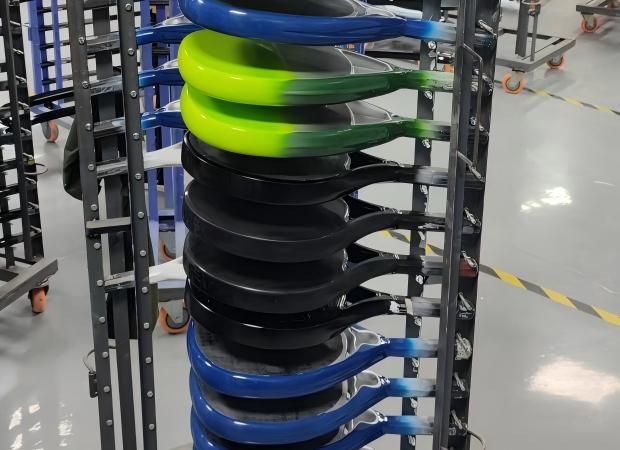
8 Key Factors That Affect the Cost of Padel Racket Manufacturing
As your OEM manufacturing partner, we believe transparency is the foundation of a long-term business relationship. In the production of padel rackets, cost is not determined by a single factor — it is the result of a combination of material science, supply chain management, and design complexity.
Generally speaking, the following 8 dimensions have the most significant impact on the final unit cost.
1. Order Quantity & Economies of Scale
This is the most direct factor affecting unit cost. The larger the production batch, the lower the fixed costs divided per racket.
-
Mold & equipment amortization: The development cost of a high-quality steel mold is significant. The larger the order quantity, the lower the mold cost per racket.
-
Raw material bulk discounts: The purchasing price of carbon fiber, EVA core, and resin is directly linked to volume. Larger orders significantly reduce material costs.
-
Machine changeover cost: Switching from Model A to Model B requires resetting and adjusting press parameters and painting robot programs. Larger orders reduce changeover frequency, thereby lowering labor cost per unit.
2. Racket Face Material: Carbon Fiber Grade & Weave Type
The face material is a core factor affecting both performance and cost.
Generally speaking, UD (unidirectional) has the lowest cost, followed by 3K. 12K and 18K are relatively more expensive.
If fiberglass is used instead of carbon fiber, the cost is typically lower, but stiffness and power response are reduced — making it more suitable for entry-level rackets.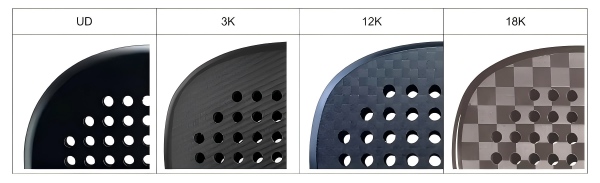
3. Customization of Components
Small accessories such as wrist straps, grips, and end caps may have a low unit price, but customization significantly affects overall cost.
-
Standard off-the-shelf parts: Using factory standard parts offers the lowest cost.
4. Painting Process & Color Complexity
Color affects not only appearance but also the time and cost of the painting process.
-
Generally speaking, black has strong coverage and requires only a single layer of spraying — simple and low-cost.
-
Other colors (color, metallic, etc.) require thicker coatings to achieve saturation and tighter color difference control, increasing cost.
-
Multi-color designs: If the design includes two or more colors, masking, multiple spraying passes, and multiple baking cycles are required. The more colors, the more steps — and the higher the cost.
5. Water Decal / Logo Transfer Method
The method used to transfer logos and patterns also creates cost differences.
-
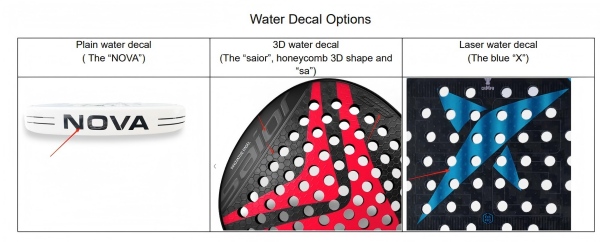
Plain water decal (screen printing): Lowest cost
-
Laser water decal: Offers a metallic or reflective effect; 3D water decal: Creates a raised, tactile logo on the racket frame — higher cost
-
6. Raw Material Origin
Generally speaking, imported carbon fiber costs more than domestic carbon fiber.
In addition, the density of the EVA core (soft / medium / hard) also significantly affects cost. Professional-grade hard EVA typically costs more than standard soft EVA.
7. Shipping Method
This is the final step in the procurement process — and often the "hidden" cost that blows the budget.
-
Air freight: Fast, but generally several times more expensive than sea freight. Suitable for samples or small urgent orders.
-
Sea freight: Most cost-effective, especially for large orders, but with a longer lead time (30–45 days).
-
Rail freight: Cost and lead time fall between air and sea, typically used for shipments to Europe.
Small orders are often forced to use air freight — a cost factor that is easily underestimated.
8. Tolerance Requirements: Higher Precision = Higher Cost
This is an "invisible but very expensive" cost factor in OEM production, and a key differentiator between standard rackets and professional-grade rackets.
When customers require tighter tolerances on parameters such as weight, balance point, or thickness:
-
More precise prepreg cutting, mold temperature control, and resin control are required
-
Yield rate drops significantly, and defective units must be scrapped or downgraded
-
Additional sorting, inspection, and rework processes are added
-
Unit cost increases significantly as a result
-
Industry insight: Brands that pursue "pro-level consistency" usually pay a premium for tighter tolerances. For the vast majority of amateur players, standard tolerances are more than sufficient.
Summary
In custom padel racket manufacturing, there is no simple "expensive" or "cheap" — only a combination of materials, processes, tolerances, and logistics. Generally speaking, from the choice of carbon fiber grade, to the number of paint colors, to tolerance stringency and shipping method — every decision affects your final cost structure.
As your manufacturing partner, we can reverse-engineer the optimal material and process combination based on your target retail price. Please feel free to contact us for detailed quotations and sample support.



Contact Us