
Padel Rackets Core: EVA Material & Performance Tuning
Padel Rackets Core: EVA Material & Performance Tuning
What is the Core? Introduction to EVA Material
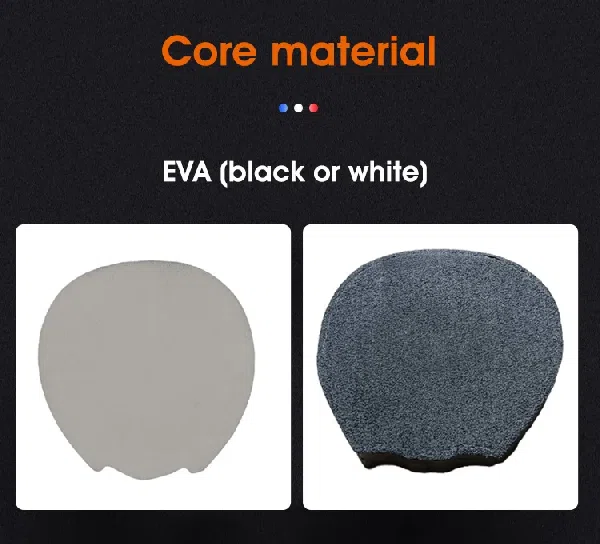
The core of a padel racket is the critical component that determines feel, ball output speed, and vibration damping. The industry standard material is EVA (Ethylene-Vinyl Acetate Copolymer), a cross-linked, foamed thermoplastic resin that forms a closed-cell foam structure. Upon impact, the core compresses to store energy, then quickly recovers its shape to return that energy to the ball, while simultaneously absorbing destructive vibrations and reducing shock transmitted to the arm.
EVA Colors
For visual identification, black and white are the most stable and widely used standard colors. While technically EVA can be dyed any color, this requires changing the masterbatch and thoroughly cleaning the production line to prevent cross-contamination that could affect physical properties. Therefore, non-black and non-white EVA typically require a Minimum Order Quantity (MOQ) for production, primarily due to production cost controls.
Black EVA is the mainstream choice for padel rackets for reasons below:
-
Black EVA has become the industry standard because it projects a professional, high-performance image. Most players and brands associate it with consistent quality and power.
-
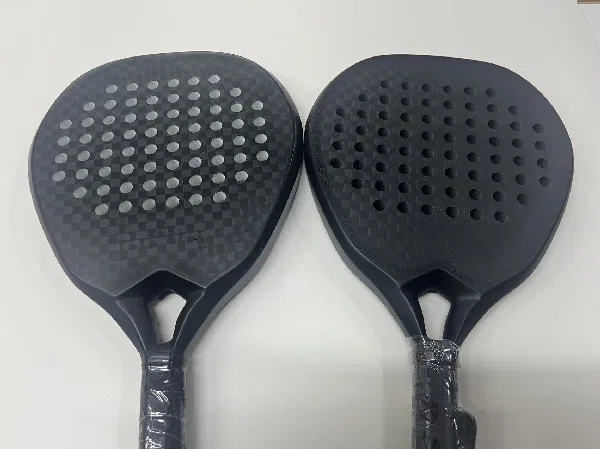
From a manufacturing perspective, white EVA is more challenging. During the painting/spray-painting process, dark-colored paints (especially black or bright colors) can easily seep into the white foam core, making it look stained, dirty, or uneven. This significantly increases the reject rate and quality control costs.
-
Black EVA hides minor imperfections much better, ensuring a cleaner final appearance without extra processing steps.
-
Tuning EVA Hardness
EVA hardness directly corresponds to a player's level and playing style. The industry typically quantifies this using the Shore A or Asker C scales. The key characteristics of the three hardness levels are compared below:
|
Property |
Soft |
Medium |
Hard |
|
Feel |
Soft, high shock absorption, long dwell time |
Balanced, solid |
Firm, direct feedback |
|
Energy Return |
Good at low/medium speeds, ceiling at high speeds |
Linear |
Extremely high at high speeds |
|
Comfort |
Highest (arm-friendly) |
Good |
Lower |
|
Target Users |
Beginners, defensive players, those with elbow sensitivity |
Intermediate, all-around players |
Professional offensive players |
Regarding the choice between the three hardness levels, Soft EVA offers a plush feel with high shock absorption and a long dwell time, providing excellent control and comfort. However, it is important to note that at high swing speeds, Soft EVA can be over-compressed, leading to energy loss and a "power ceiling" phenomenon. Medium EVA provides a balanced, solid feel with linear energy return, suitable for intermediate and all-around players. Hard EVA feels firm with direct feedback, releasing tremendous rebound power on high-speed swings, but it requires very high swing speeds to activate its elasticity. At low to medium speeds, it feels stiff, and off-center hits feel harsh; some users describe it as "playing like wood." Therefore, non-professional players should choose Hard EVA with caution.
The final hardness of EVA is determined by two independent variables. The first is the base formulation, including Vinyl Acetate (VA) content and cross-linking degree. Higher VA content makes the material more flexible, while a higher cross-linking degree makes it harder and increases rebound speed. The second is the foam density: within the same formulation, higher density results in a harder and heavier material. Production requires controlling both dimensions to lock in the intended feel.
Density has a direct impact on weight distribution. Soft EVA has lower density and a lighter overall weight, so weight must be added to the racket's head to reach the standard weight (350-375g), creating a head-heavy balance. Medium EVA has moderate density, allowing weight placement to be adjusted according to design needs. Hard EVA has higher density and is already relatively heavy, leaving no room for additional head weighting without exceeding the limit. As a result, its weight is distributed relatively evenly across the racket, resulting in an (even-balance) profile.
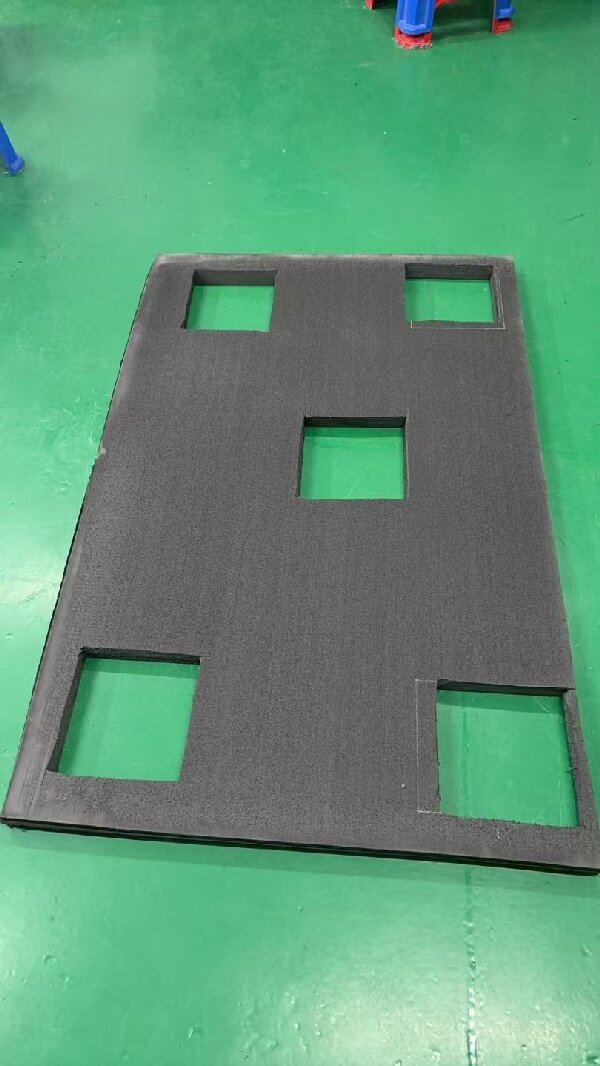
To ensure consistency of feel between production batches, strict density spot-checks are performed during manufacturing. We use the mass-volume measurement method: five key points (four corners and the center) are selected on a large EVA sheet, samples of equal area are cut from each point, and they are weighed using a high-precision analytical balance to calculate density. The density variation across the five points must remain within tolerance (e.g., ±5%); otherwise, the batch is rejected due to inconsistent mixing or foaming defects.
To break the zero-sum game of "soft = control, hard = power," the industry has introduced multi-density layer technology. Dual-density structures typically feature a soft outer layer and a hard inner layer. The soft outer layer absorbs harsh vibrations and enhances control, while the hard inner layer provides rigid rebound support upon deep compression, delivering "comfortable power." Three-layer sandwich structures, such as Soft-Hard-Soft, feature soft outer layers for shock absorption and ball pocketing, with a hard middle layer ensuring high ball exit speed, suitable for top players seeking maximum speed without sacrificing comfort.
Racket Shape and EVA Configuration
The recommended pairing logic between racket shape and EVA hardness is as follows:
|
Shape |
Recommended Hardness |
Balance Point |
Target Users |
|
Soft |
Head-heavy |
Beginners, defensive players, control priority |
|
|
Soft / Medium |
Even / Slightly head-heavy |
Intermediate players, all-around |
|
|
Medium / Hard |
Head-heavy (Medium) / Even (Hard) |
Offensive (Medium) / Pro offensive (Hard) |
Specifically, round rackets feature a large sweet spot and low center of gravity. They are recommended with Soft EVA, as the soft core enhances control and reduces twisting on off-center hits, making them ideal for beginners, defensive players, and those prioritizing control. Teardrop rackets have a moderate balance point and can be paired with Soft or Medium EVA: soft cores lean toward control, while medium cores offer all-around performance, suitable for intermediate and all-around players. Diamond-shaped rackets have a head-heavy balance point and are recommended with Medium or Hard EVA. The Medium version provides head-heavy balance and ample power output for offensive players. The Hard version, with its heavier overall weight and even balance, is suited for professional offensive players but requires a higher skill level to handle effectively.
Additional Topic: EVA Fatigue and Compression Set
Beyond initial hardness, buyers and advanced players should pay attention to compression set, a key indicator of long-term performance. Under repeated impacts, the cell walls within EVA can gradually collapse or lose elasticity, causing the racket to feel "loose" over time and lose its original rebound power. When evaluating suppliers, we require the compression set value (e.g., less than 15% after 22 hours at 70°C under 50% compression). EVA formulated with a high degree of cross-linking exhibits stronger memory recovery, resulting in a longer performance life for the racket. This is a core cost difference between high-end and entry-level rackets.



Contact Us